RenterEase is reader-supported. When you buy through links on our site, we may earn an affiliate commission. Learn more
Choosing a standing desk floor protection mat layout is one of the most frustrating bottlenecks you will face when setting up a remote home workspace. If your apartment office has thick carpeting or a raw concrete floor, basic factory desk guides are usually enough to keep your setup stable. However, when your workstation sits on delicate luxury vinyl plank (LVP), engineered hardwood, or thin laminate, you run into a major conflict between smooth rolling chair mobility and heavy structural floor protection.
Standard internet buying guides tell you to just buy any cheap plastic sheet to stop surface scratches. This surface-level advice completely ignores how heavy sit-stand furniture behaves over time. To protect your security deposit and avoid permanent property damage, you need to understand the exact physical forces crushing your floorboards from underneath.
When setting up a high-performance workspace in tight square footage, picking the right frame geometry is only half the battle. While deploying one of the 10 best narrow desks for small apartments solves your immediate spatial layout constraints, loading a slim, tall frame with heavy monitor arms concentrates intense downward forces on a very localized area of your flooring.
1. The Under-Desk Conflict: Why a Standing Desk Changes Floor Protection Mat Requirements
Traditional office desks distribute a light, unmoving weight evenly down four legs. A modern adjustable standing desk behaves completely differently. These frames are heavily back-weighted due to robust steel lifting columns, multi-monitor arms, heavy desktop slabs, and computing hardware. When you raise the desk to a standing height, you shift its entire center of gravity upward. This high center of mass transforms your desk frame into a giant, hyper-sensitive leverage pendulum.
Every time you type intensely, rest your forearms on the desktop edge, or lean against the workspace, you generate continuous downward forces. As these forces travel down the tall legs, they compress into highly concentrated pressure points right at the floor layer.
If your home office workstation is resting on deep pile rugs, you face a completely different stabilization baseline. Renters dealing with fibers and spongy padding underlayment should reference our step-by-step manual on how to stop desk from shaking on carpet to deploy subfloor-penetrating spikes. However, when transitioning to luxury vinyl planks or hardwood, your engineering priority shifts from piercing fibers to distributing high point-load compression.
The Stationary Foot Crashing Trap
Standard search results focus entirely on your office chair wheels, completely ignoring the stationary feet of the standing desk itself. When your desk is extended to a 42-inch height baseline, your typing movements create a high-leverage horizontal sway. If the heavy metal desk feet sit directly on top of a soft, cheap plastic mat, the legs will slowly slide, tilt, and dig into the edge of the material. This continuous movement slices microscopic tears straight through the mat over a 6-month period, punching deep, irreversible rectangular indentations directly into the rental vinyl planks below.
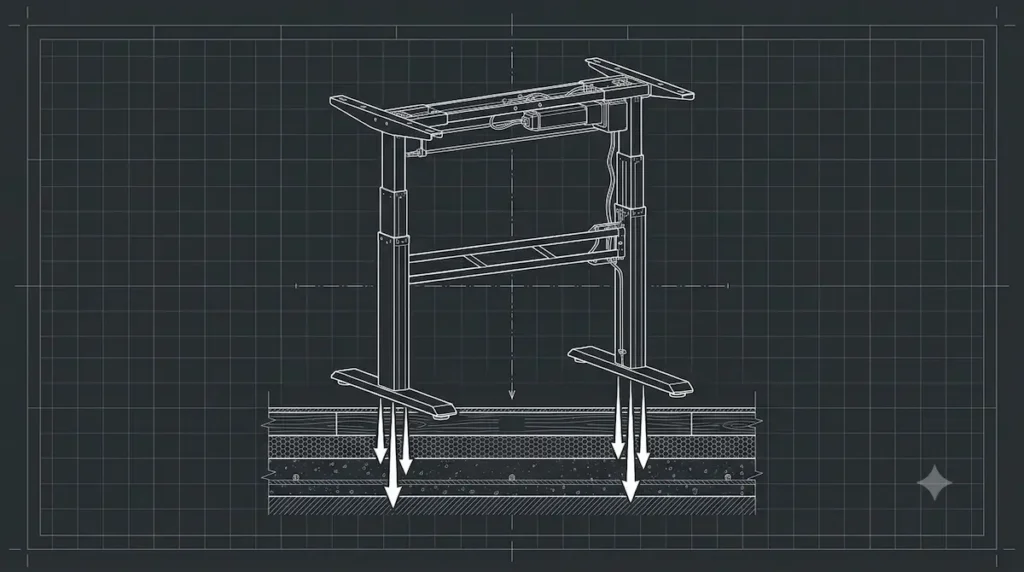
📐 INFRASTRUCTURE BLUEPRINT BREAKDOWN: FLOOR VARIANCE FORCES
- High-Leverage Pendulum Force: Raising your desk multiplies dynamic downward point-load compression by up to 40% during everyday working movements.
- The Caster Wheel Pressure Vector: Standard small nylon chair wheels trap intense weight on microscopic surface areas, accelerating deep floor grooving.
- The Sandpaper Debris Trap: Microscopic dust and outdoor grit trapped beneath shifting, flexible mats grind continuously into your floor’s clear coat with every step you take.
2. Material Architecture: Choosing a Rigid Standing Desk Floor Protection Mat
To protect your apartment floor without ruining your office chair mobility, you must bypass low-grade, flexible plastic mats entirely. Cheap vinyl floor mats are highly elastic. Under heavy weight, they stretch and dimple instantly, trapping your chair wheels in deep ruts that force you to strain your back just to move.
We have all been there: you roll your chair forward an inch to grab your coffee mug, and your wheels immediately slip right back down into the annoying plastic indentations you made yesterday[Visual: Imagine your office chair wheels getting trapped in a deep, annoying mat pothole]. You end up having to physically hoist your body weight up just to pull your seat out of a plastic rut. It is a frustrating, constant micro-annoyance that completely breaks your deep-work focus block. Instead, your structural layout strategy should rely on rigid material architectures:
Type A: High-Density Polycarbonate Solid Plates
Polycarbonate is a heavy-duty polymer engineered to withstand high impacts without bending. A rigid polycarbonate mat acts as a solid bridge, distributing your body weight and chair downforce evenly across a wide surface area. This completely prevents chair wheels from sinking, giving you a smooth roll while insulating delicate planks from indentation failure.
To add an extra layer of structural buffering underneath a massive dual-motor frame, consider pairing your rigid plate with specialized floor pads [Visual: A super-strong electric standing desk that hides a hidden motor inside each leg to lift heavy screens]. Integrating the best heavy duty anti-vibration pads for desks directly underneath the stationary metal desk feet absorbs dynamic micro-shocks, keeping the rigid mat from grinding against your floor boards.
Type B: Tempered Glass Structural Panels
For the absolute highest level of protection, tempered glass offers zero visual deflection. It provides an entirely flat, immovable baseline that never warps, clouds, or degrades over time. Glass panels allow task chair wheels to glide with almost zero rolling resistance, completely isolating your apartment floorboards from rolling friction.
The Hidden LVP “Click-Lock” Seam Snap
Ordinary product roundups claim that a floor mat’s only job is to stop surface scratches. They completely fail to understand how modern Luxury Vinyl Plank (LVP) floors are put together underneath. LVP floors use thin, interlocking plastic tongues to stay joined together as a floating floor.
When a heavy office chair rolls back and forth over a highly flexible vinyl mat, the soft plastic bows under pressure. This forces the underlying floor planks to bend up and down continuously. Within 90 days of heavy typing shifts, this localized bending snaps the fragile interlocking joints hidden beneath the surface. This causes the planks to permanently pull apart, buckle, and gape—a hidden structural destruction that a thin, flexible mat can never prevent. If you are escalating your setup mass to handle enterprise-grade server cabinet racks, point-load forces scale up dramatically. Consequently, you must reference our specialized manual on deploying local AI server home labs to learn how to construct a non-destructive weight dispersal platform flat across multiple structural floor joists.
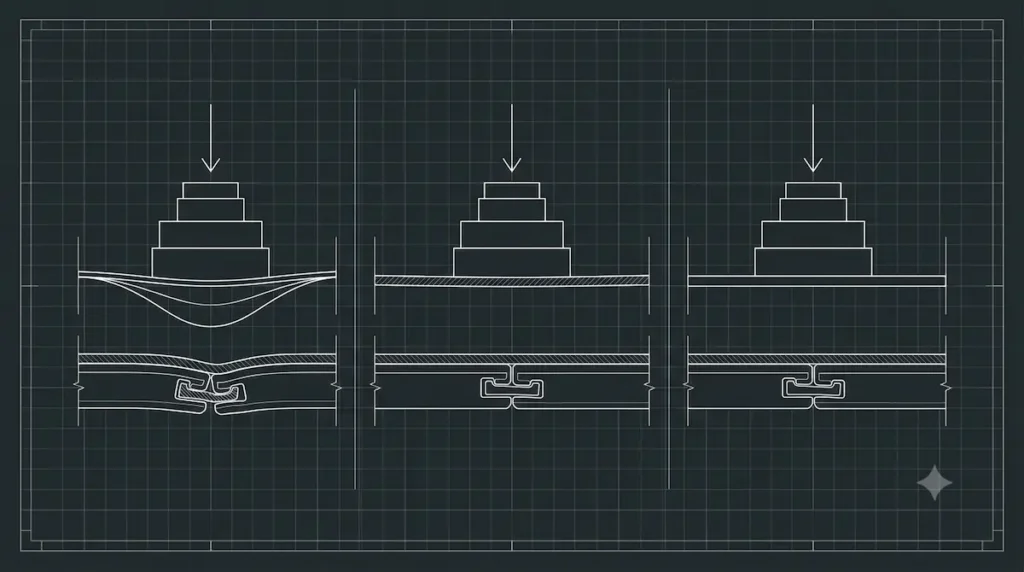
🔬 MECHANICAL COMPARISON ANALYSIS: MATRIX LOADING PERFORMANCE
- The PVC Failure Mode: Flexible vinyl mats stretch and dimple under heavy use, locking wheels into fixed ruts and breaking underlying plank joints.
- The Polycarbonate Defense: Rigid polymers absorb intense caster wheel stress and spread it over a wide surface, keeping your floor planks flat.
- The Glass Isolation Anchor: Tempered glass panels provide zero deflection under weight, keeping chair wheels level and completely eliminating subfloor bending.
3. The Plasticizer Migration Hazard (The Invisible Security Deposit Trap)
The single most dangerous threat to your tenant security deposit isn’t a noticeable surface scratch—it is a silent chemical reaction known as plasticizer migration. Cheap, flexible vinyl floor mats require oily chemical additives called plasticizers to keep the plastic bendable and soft.
When a heavy standing desk setup presses a flexible PVC mat firmly against a vinyl floor or polyurethane hardwood finish for months, these chemicals slowly leach out of the mat. The migrating plasticizers chemically fuse with the floor’s clear factory top coat, creating a dark, permanent yellow or brown chemical discoloration stain that mirrors the mat’s shape exactly.
📊 INFRASTRUCTURE STRESS PROFILE
Operating a high-performance remote computing rig over floor protection plates generates significant dynamic friction thermal heat, making it crucial to monitor your circuit load thresholds. Before running heavy computational cycles, access our digital home office circuit calculator to verify your simultaneous wattage signature remains within safe continuous load boundaries.
To verify these dimensional stress limits against official regulatory frameworks, you can cross-reference the active ergonomic guidelines outlined by the OSHA Computer Workstations Directory. While federal workspace parameters focus primarily on joint alignment, mechanical clearance lanes, and structural height adjustments to maintain individual physiological safety, these same height-adjustable rules dictate the localized downforce sways that ultimately cause your underlying flooring underlayment to buckle.
The Friction-Heat Fusion
Other sites think these stains happen simply because a mat is dirty. In reality, it is a permanent chemical weld triggered by friction heat. Every time you roll your task chair wheels back and forth, the intense localized pressure creates low-level thermal energy. This heat accelerates the migration of the oily chemical additives. The moment you pull up a cheap mat at the end of your lease, you will literally tear away pieces of the floor’s top coat, permanently ruining the floor profile. Utilizing rigid, non-destructive polycarbonate or tempered glass completely eliminates this risk, as these hard materials do not require flexible chemical additives.
🔒 SYSTEM ACCESS: THE LEASE-SAFE WORKSPACE DEPLOYMENT PACKAGE
Download the definitive blueprint to neutralize point-load compression and guarantee a flawless move-out inspection.
- 📋 APARTMENT DEPOSIT PROTECTION CHECKLIST: Your step-by-step physical verification manual to stop plasticizer chemical migration, prevent click-lock seam snapping, and completely eliminate underlayment dipping liabilities.
- 📐 APPROVED INFRASTRUCTURE COMPONENT FRAMEWORK: A data-dense engineering layout mapping exact material tolerances, load-dispersal parameters, and independent test ratings for high-tensile polycarbonate and tempered glass panels.
👉
Join 14,000+ remote infrastructure engineers who receive our data-dense, landlord-compliant hardware setup configurations.
4. The 3-Step Protocol to Optimize Your Standing Desk Floor Protection Mat Setup
To protect your property foundation and ensure your floor is completely pristine when it is time to move out, follow this exact optimization protocol:
- Step 1: The Clearance Path Setup: If you use a soft anti-fatigue foam mat for foot comfort while standing, do not let your chair wheels roll over it. Install a dedicated wall hook or a clean storage slot next to your desk. This allows you to easily slide the soft cushion out of the way when transitioning back to sitting mode on your rigid protector mat. Let’s be honest: no one wants to do a full gymnastics routine every time they hit the desk button to stand up. If you leave your soft anti-fatigue cushion floating on top of your hard plastic protector, you will end up constantly kicking it out of the way with your heel, or catching your chair wheels on the foam border when you slide your seat back under the desk.
- Step 2: Microscopic Debris Sweeping: Before laying down your rigid polycarbonate or glass panel, thoroughly sweep and clean the floor space. If microscopic dust, sand, or drywall grit gets trapped beneath a hard panel, your daily movements will turn those particles into an abrasive sandpaper layer that will grind scratches into your floorboards.
- Step 3: The Move-Out Friction Clean: When your lease ends, remove the protection mat and run a micro-fiber cleaning cloth across the area. Wipe away any minor texture variations using a specialized neutral-pH flooring spray to leave a flawless surface. There is nothing more stressful than watching your landlord walk into your empty bedroom with a clipboard, kneeling down to look for reasons to keep your money. Taking two minutes to spray down the area ensures that when they shine a flashlight across the floorboards, they see an immaculate, uniform sheen with zero phantom ring outlines.
🧠 ABOUT THE ENGINEERING CURATION DESK
RenterEase is an independent architectural workspace lab managed by remote software infrastructure designers. We analyze home office setups through the strict lens of structural load physics, spatial tracking calibration, and damage-free apartment property integration. By bypassing superficial lifestyle decor reviews, our staging team provides raw, data-dense technical blueprints engineered to protect both your daily physiological work performance and your long-term tenant security deposit.
🛒 Affiliate Disclosure & Property Compliance Policy
RenterEase is a data-dense, reader-supported platform built on absolute structural transparency. When you deploy workspace protection assets, load-distribution polycarbonate plates, or lease-safe tempered glass floor shields through the curated links across our technical manuals, we may earn a localized tracking commission from our retail partners at completely zero additional cost to your account. We exclusively analyze and highlight rigid, non-destructive floor-defense systems that meet our strict independent engineering standards for complete subfloor protection and landlord-compliant property restoration. Learn more in our global Terms of Use & Product Liability Disclaimers.
⚖️ Product Liability & Structural Weight Disclaimer
The load-distribution formulas, material shear ratings, and floor-defense setups detailed across this manual are compiled strictly for general educational and informational purposes. RenterEase does not provide professional structural engineering services or licensed architectural contracting advice. Actual subfloor composition, luxury vinyl plank (LVP) tongue-and-groove tensile limits, factory polyurethane thickness, and underlying apartment framing variables differ significantly across residential properties.
The installation of high-density polycarbonate sheets, tempered glass panels, or aftermarket task chair caster wheels is executed entirely at the user’s individual risk. RenterEase, its structural editors, and its parent entities accept completely zero financial liability or legal responsibility for localized underlayment dipping, click-lock joint snapping, cosmetic finishes scratching, plasticizer migration chemical stains, or any security deposit deductions incurred during independent property modifications. Always cross-reference your specific furniture manual weight parameters against your rental lease structural parameters.
Pingback: 10 Aesthetic Tiny Bedroom Office Layouts (Sizing Blueprints)
Pingback: Best Pole Mount Monitor Arms: 4 Brackets for Renters
Pingback: 5 Best Floor-to-Ceiling Tension Poles for Apartment Offices (2026 Picks)