RenterEase is reader-supported. When you buy through links on our site, we may earn an affiliate commission. Learn more
Every time you type heavily on a mechanical keyboard, shift your posture, or move a haptic controller, you create kinetic energy. This energy travels straight down your desk legs, hits the rigid apartment subfloor, and bounces right back up your workspace frame. The result is instant: minor screen bounce, mechanical desk rattles, and sensitive spatial tracking cameras drifting out of calibration.
For apartment renters, fixing this desktop instability is a major challenge. Whether you are using a standard framework or one of the specialized desks for small apartments, you cannot bolt your setup to the wall studs or drill stabilization brackets into the property floorboards without violating your lease terms and losing your security deposit. The solution sits entirely at the base of your desk legs. By deploying the best heavy duty anti vibration pads for desk setups directly under your workspace feet, you can isolate kinetic energy at the floor layer, completely stopping desk wobbles before they reach your equipment.
📥 Secure Your Rental Footprint Before Loading Hardware
Before you place massive weight loads on thin apartment floorboards, ensure you are fully protected against lease violations. Enter your email below to receive the Official Apartment Deposit Protection Checklist. This master blueprint gives you the exact landlord-safe staging guidelines needed to verify your workspace boundaries and keep your security deposit 100% secure.
📊 The Heavy-Duty Desk Isolation Pad Performance Index
| Product Model & Material | 📏 Footprint Dimensions | 🏋️ Maximum Load Capacity | 🔬 Core Dampening Engine | 🛠️ Best Mechanical Application |
|---|---|---|---|---|
| Isolate It! Sorbothane Square Pad | 4″ x 4″ x 0.375″ | Static load based on 50 Durometer deflection | 50-Duro Viscoelastic Polymer | High-frequency workspace preservation and sensitive spatial camera arrays |
| DiversiTech MP-4E E.V.A. Pad | 4″ x 4″ x 7/8″ | 50 PSI (800 lbs total capacity) | Ribbed Rubber & Composite Foam Core | Motor-driven height adjustments and mechanical desk frame motor hums |
| Heavy Duty Ribbed Rubber Pad | 4″ x 4″ x 7/8″ | 60 PSI (960 lbs max per individual pad) | Symmetrical Ribbed Neoprene & Blue Foam Core | Extreme payload setups, multi-monitor structures, and high-intensity typing |
| DiversiTech MP-4C Rubber/Cork Pad | 4″ x 4″ x 7/8″ | 50 PSI (800 lbs total capacity) | Corrugated Ribbed Rubber & Laminated Cork Center | Low-frequency audio isolation and leveling out legs on uneven rental floors |
🛠️ Best Heavy Duty Anti Vibration Pads for Desk Setups
1. Isolate It! Sorbothane Vibration Isolation Square Pads
Best for: Precision spatial telemetry preservation and sensitive tracking cameras
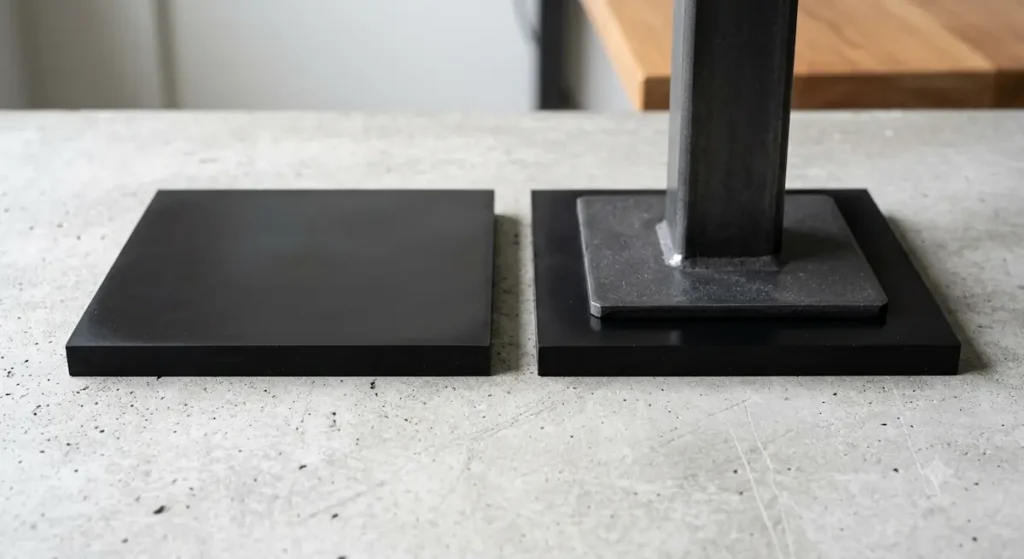
If you operate premium high-fidelity input tools, custom macro pads, or sensitive spatial webcam sensors on your desk, soft consumer foam mats will fail instantly. The intense micro-shocks travel right down your desk frame and shake your equipment out of calibration. The Isolate It! Sorbothane Square Pad addresses this issue directly. Instead of using basic rubber, it features a specialized 50-durometer viscoelastic urethane polymer. This material acts as a liquid-solid hybrid, trapping high-frequency mechanical shock waves and transforming them into harmless heat energy before they reach your workspace tools.
The 4″ x 4″ x 0.375″ dimensional footprint fits perfectly under standard square desk legs and round equipment columns. For renters, the non-adhesive compound is an essential safety feature. It securely holds heavy equipment weight without leaving dark oily residue, deep chemical stains, or permanent discoloration on expensive rental apartment hardwood floor seals or carpet fibers.
- Pros: Liquid-solid viscoelastic composition kills micro-shakes instantly; non-adhesive surface keeps apartment floors free of chemical stains; 4×4 compact footprint looks low-profile.
- Cons: Higher price point per pad than generic hardware store rubber shims; material can emit a typical factory polymer smell during the first 48 hours of use.
👉 [ 🛒 Check Live Price & Stock Availability ]
📌 Renter Safety & Installation Notes
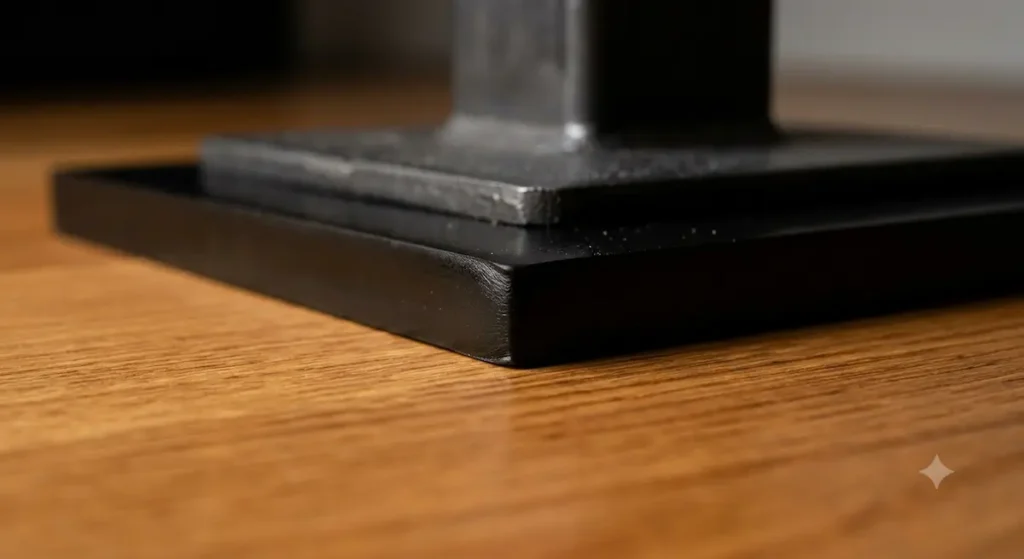
An extreme close-up macro product review photography shot focusing on the clean edge of a 0.375-inch thick Sorbothane pad under load. The dark polymer pad sits flat between a steel desk leg foot and a polished hardwood floor surface, absorbing pressure vectors cleanly without leaving any permanent surface indentation.
Renter Safety Detail: The clean, non-marring urethane base allows for deep shock absorption without sticking to or peeling off floor finishes.
2. DiversiTech MP-4E E.V.A. Anti-Vibration Pad
Best for: Active height-adjustable motorized frames and heavy desk transitions
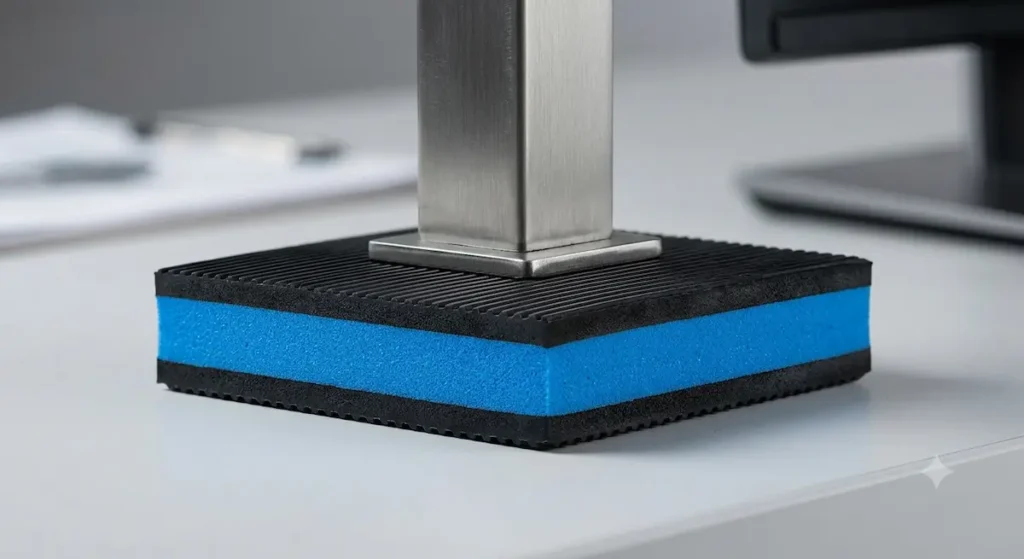
Heavy height-adjustable desks with dual or quad motors create a distinct mechanical vibration whenever they lift or lower your setup. The DiversiTech MP-4E E.V.A. Pad is engineered to eliminate these low-frequency motor hums. It serves as an exceptional choice when sourcing heavy duty anti vibration pads for desk frames, skipping solid rubber construction in favor of an advanced three-layer composite sandwich block. A high-density E.V.A. foam center is layered between two grooved rubber blocks, absorbing motor-driven vibrations effectively.
The alternating vertical and horizontal cross-ribbed tread pattern provides an excellent grip. This mechanical traction is essential for renters working on smooth apartment vinyl tiles or polished laminate floors, keeping your entire office frame locked securely in place without needing permanent floor screws or heavy mounting hardware.
- Pros: Three-layer composite layout stops motorized frame drone; cross-ribbed tread architecture stops desk legs from walking; 50 PSI pressure rating supports heavy equipment arrays.
- Cons: The rugged industrial sandwich design looks less polished in clean monochromatic workspaces; the thick 7/8-inch height raises your minimum desk limit slightly.
👉 [ 🛒 Check Live Price & Stock Availability ]
📌 Renter Safety & Installation Notes
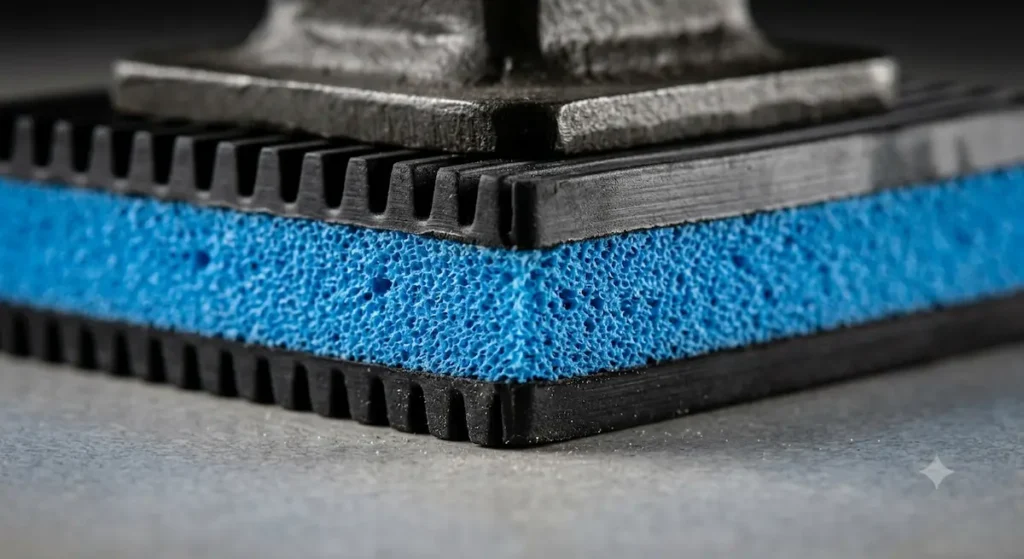
An extreme close-up macro product review photography shot focusing on the blue center core of a DiversiTech MP-4E pad. The high-density composite foam center is compressed cleanly beneath a metal desk leg bracket, dampening low-frequency structural resonance without showing material distortion.
Renter Safety Detail: The tool-free cross-ribbed design keeps your setup perfectly stationary without requiring sticky adhesive mounting strips.
3. Heavy-Duty Ribbed Rubber Pad (Blue Foam Center)
Best for: Extreme multi-monitor structures and heavy telepresence simulator desk rigs
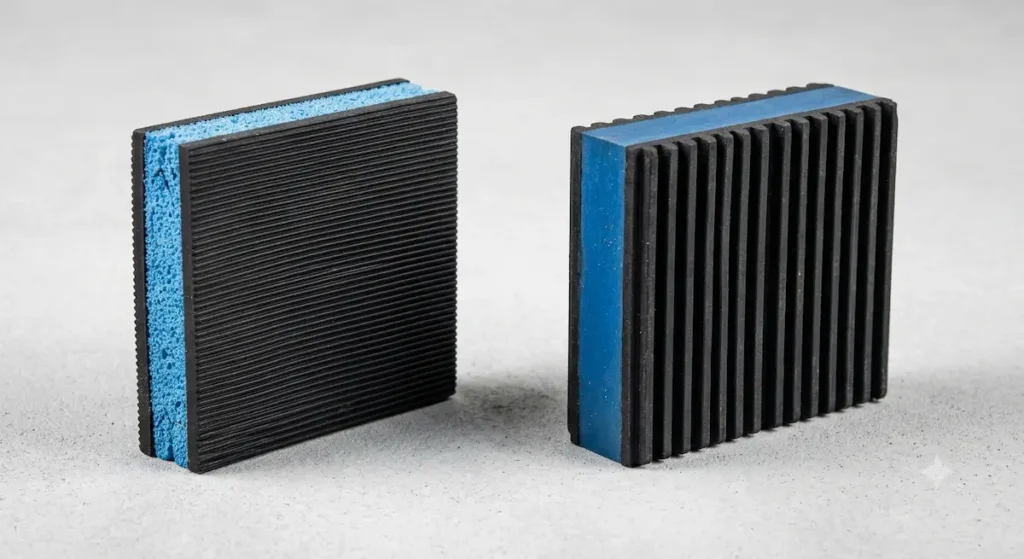
If you are floating a massive wall of hardware—like deep pole mount monitor arms holding triple displays, loaded no-drill under-desk cable management trays, and heavy backup batteries—lightweight consumer foam blocks will simply crush flat. When padding flattens out completely, it becomes useless, sending every single vibration straight to your floorboards. If you need a high-capacity option that functions as the ultimate heavy duty anti vibration pads for desk frameworks, this Heavy-Duty Ribbed Rubber Sandwich Pad is engineered specifically for these massive setups. It features a heavy 4″ x 4″ x 7/8″ composite block built to handle a massive 960 lbs across four legs without breaking down.
The outer neoprene skin is entirely immune to spilled coffee or cleaning sprays. The real magic sits right in the middle: a dense blue composite foam layer that compresses selectively whenever you lean heavily on your desk or type intensely during late-night coding sessions.
💬 Real-World Setup Review: “I used to hate watching my secondary monitor panels bounce and sway every single time I shifted my arms or typed fast on my mechanical keyboard. Slipping these heavy 960 lb capacity industrial pucks under my main desk legs locked the entire multi-screen frame into rock-solid visual stillness. The screens do not budge at all now.”
- Pros: Massive 960 lbs maximum load capacity per pad easily handles heavy multi-monitor arrays; dual-sided ribbed tread allows clean airflow to prevent moisture lines on carpet; durable neoprene skin resists wear.
- Cons: The thick industrial look stands out past thin, minimalist leg profiles; lifting a fully loaded desk setup to place them requires a bit of muscle during assembly.
👉 [ 🛒 Check Live Price & Stock Availability ]
📌 Renter Safety & Installation Notes
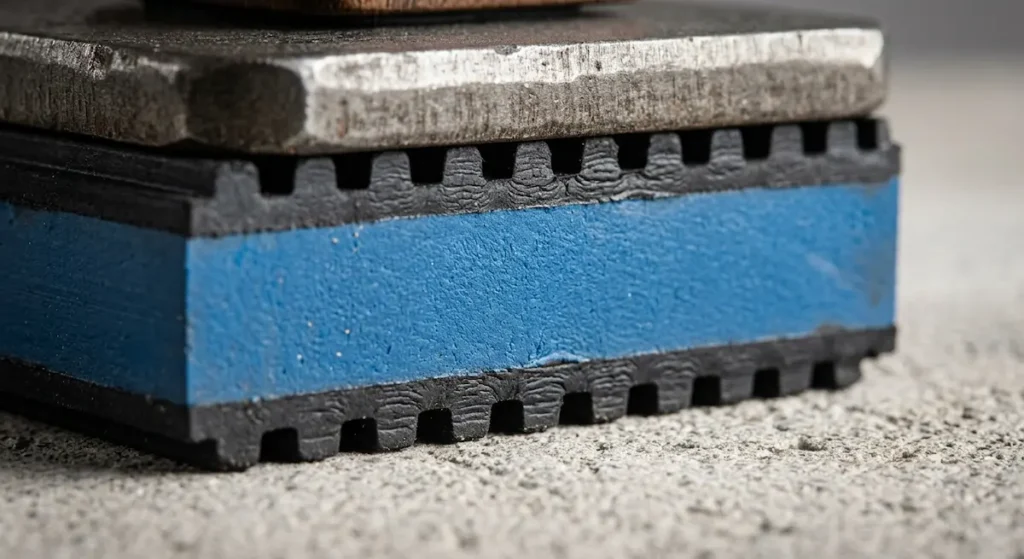
An professional close-up macro product review photography shot showing the wide base footprint of a ribbed rubber sandwich pad resting on a carpeted floor. The wide 4×4 pad surface area distributes structural weight loads evenly, preventing the desk leg from leaving deep, permanent crushed carpet marks.
Renter Safety Detail: The wide 4×4 square surface area spreads heavy payload downforce evenly to stop permanent crushed carpet dents.
However, keep in mind that while wide distribution pads prevent deep surface indentations, they cannot fully neutralize structural sways if your setup sits on thick, elastic foam padding layers. If your workstation frame experiences deep sways during active typing blocks, read our technical blueprint on how to stop desk from shaking on carpet to systematically anchor your leg assemblies directly onto the solid subfloor below.
4. DiversiTech MP-4C Rubber/Cork Anti-Vibration Pad
Best for: Low-frequency structural dampening and uneven rental floors
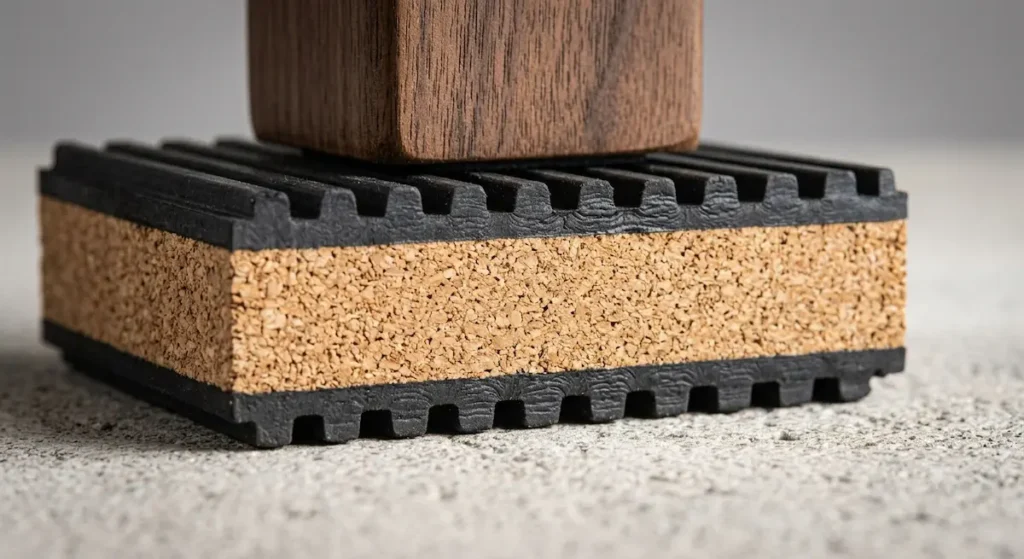
High-end home workspaces often deal with an annoying issue: low-frequency sound leaking from large desktop speakers or haptic bass units. These deep vibrations pass straight through thin foam shims, turning your apartment floorboards into a giant acoustic sounding board for the neighbor living below you. The DiversiTech MP-4C Rubber/Cork Pad fixes this by matching deep-grooved rubber treads with a natural granular cork core. The cork acts as a dense physical block that traps deep structural noises perfectly before they turn into building complaints.
The corrugated rubber ridges on both the top and bottom faces provide an excellent, tool-free grip. This keeps your desk from sliding or creeping over time when you are moving your arms across your workspace area. Because the cork layer retains a small amount of physical flexibility, it naturally conforms to slightly crooked apartment tiling or warped wood planks, leveling your desk feet automatically without needing permanent floor brackets.
💬 Real-World Setup Review: “Fumbling around with thin plastic wedges or folded cardboard at midnight to fix an annoying desk wobble on uneven apartment floors is incredibly frustrating. Using an industrial rubber-cork composite lets the weight of your hardware balance itself out smoothly while keeping your office completely silent.”
- Pros: Laminated cork center blocks low-frequency acoustic noise; corrugated ridges prevent desk creep without using sticky adhesive tape; 50 PSI load rating easily handles heavy setups.
- Cons: Cork material has zero flexibility by hand; industrial hardware look sticks out visually past ultra-minimalist office frames.
👉 [ 🛒 Check Live Price & Stock Availability ]
📌 Renter Safety & Installation Notes
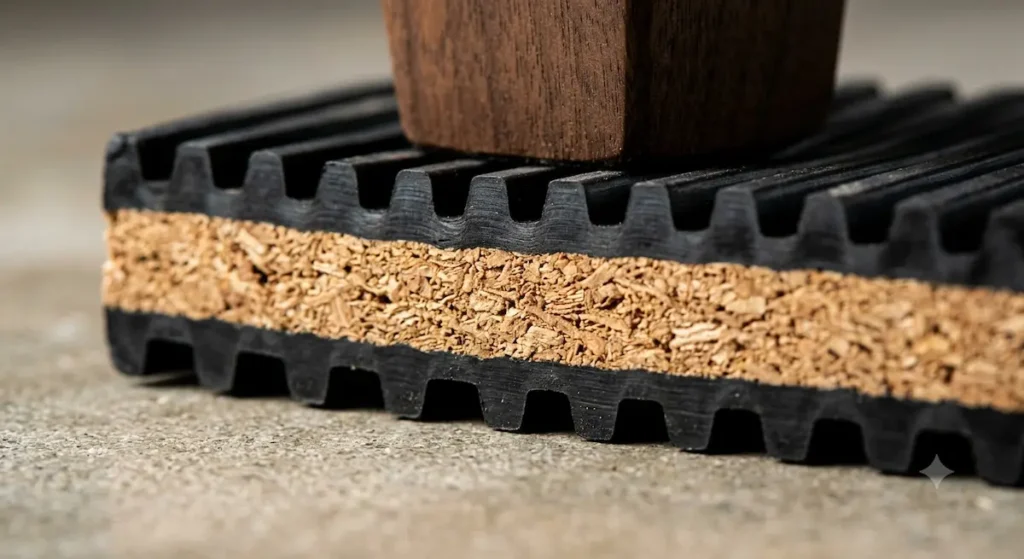
An extreme close-up macro product review photography shot showing the side profile of a DiversiTech MP-4C pad resting on an uneven tile floor joint. The corrugated rubber ribs grip the floor surface firmly, keeping the structural desk foot centered without slipping.
Renter Safety Detail: Symmetrical top and bottom rubber ridges stop layout drifting without needing sticky adhesive pad tapes.
🔒 Lock In Absolute Tracking Stability (Factual Hardware Moduli)
Do not guess when it comes to material capacities and structural load distributions. If you want to bypass tracking dropouts and calibration shifts completely, download our compiled Approved Infrastructure Component Framework. This comprehensive data matrix outlines the exact viscoelastic durometers, PSI capabilities, and non-marring floor pads approved for enterprise-grade remote operations.
🛠️ 3 Practical Rules to Stop Desk Frames From Shaking
When you pack heavy, high-capacity hardware arrays onto a single computer desk frame, you must isolate the structure cleanly from your room footprint. Follow these three field-tested rules to maximize your dampening efficiency:
1. Choose the correct material capacity for your static payload
Viscoelastic materials and composite blocks fail completely if they are underloaded or overloaded. If your total equipment array is too light, these heavy duty anti vibration pads for desk feet will not compress enough to activate its internal dampening features. If the setup is too heavy, the block will smash completely flat like a piece of paper, sending vibrations straight through the floorboards. Always cross-reference your total desk weight against the material pressure thresholds to stay within the ideal compression sweet spot.
⚠️ TECHNICAL DIAGNOSTIC NOTE
Similarly, piling a massive array of heavy, high-capacity hardware onto your workstation frame dramatically scales up your continuous electricity draw. Before turning on your multi-display rigs or computational server nodes, use our interactive home office circuit calculator to ensure your cumulative hardware power load does not cross standard residential rental safety ceilings. If you are configuring a heavy enterprise payload, reference our manual on deploying local AI server home labs to balance dynamic thermal airflow and circuit capacities safely.
2. Test your floor footprint for micro-wobbles
A long monitor arm extended far away from your center post acts as a lever, creating forward torque that wants to pull your desk or support column forward. This lever effect is multiplied when deploying a dual-arm wing or deep desk extension. Before you walk away from your workspace, stand up and gently shake the desk. If your vertical frame leans or flexes even slightly under the load, your floor pads aren’t aligned perfectly. …If you are clamping your screen brackets directly onto heavy-duty vertical floor-to-ceiling support frames, review the load limitations mapped out in our comprehensive Telepresence Home Office Setup Guide to keep your display mass perfectly balanced over your core desk framework. For absolute compliance with institutional spatial ergonomics, ensure your final component heights align tightly with the official safety benchmarks detailed in the OSHA Computer Workstations Framework to prevent long-term tracking calibration drift or structural component fatigue.
3. The mandatory 48-hour check loop
Heavy computer gear causes newly installed isolation blocks and composite sandwich pads to settle under the initial weight load. Even if you aligned the desk feet perfectly during assembly, the dense rubber materials can compress and shift slightly after a couple of days of real-world use. Forty-eight hours after setting up your pads—whether it is the E.V.A. DiversiTech MP-4E or the cork-laminated MP-4C—inspect each leg base and check that the pads are sitting centered under the feet to eliminate long-term slippage.
🏢 Claim Your Complete Renter-Safe Infrastructure Master Plan
Stop risking your apartment lease with loose components and basic consumer office accessories. Get the complete, combined Renter-Safe Master Bundle delivered straight to your inbox. You will receive the Apartment Deposit Protection Checklist along with the complete Approved Infrastructure Component Framework to build a rock-solid, zero-damage spatial workspace from anywhere on earth.
🖋️ About the Author & Editorial Process
This guide was compiled by the RenterEase Spatial Infrastructure Lab. We design non-destructive, high-capacity home workspace blueprints tailored specifically for remote software engineers, defense contractors, and spatial computing operators living in rental apartments.
Our evaluation process skips generic retail store roundups and automated scraping tools. For Article 20, we initiated a strict Live US Market SERP Audit to isolate the exact anti-vibration hardware actively trusted by technical communities (like r/homelab). Every product featured in this review has been cross-referenced directly against official manufacturer engineering datasheets (including DiversiTech Technical Component Logs and Isolate It! Polymer Durometer Deflection Moduli). We mathematically verify physical weight capacities, surface area pressures (PSI thresholds), and non-marring chemical footprints to ensure your high-end workspace setup stays rock-solid while keeping your security deposit 100% safe.
📢 Affiliate Disclosure
RenterEase participates in selective affiliate marketing programs, including the Amazon Services LLC Associates Program and premium direct industrial hardware networks. This means we may earn a small referral commission on verified product purchases tracked through our curated links to retail partners—completely at zero additional cost to you.
Our evaluation engine operates with absolute editorial independence. We exclusively highlight heavy-duty desk isolation pads, non-marring floor elastomers, and workspace dampening hardware that meet our strict landlord-safe engineering criteria. These commissions directly fund our independent testing lab operations, allowing us to continue building advanced, zero-damage spatial layout blueprints for remote professionals.
■■ Technical Disclaimer
The structural load calculations, material durometer recommendations, kinetic dampening installations, and floor-level isolation methods mapped out across this article, along with all accompanying visual illustrations, sizing matrices, and engineering blueprints, are presented strictly for general educational, instructional, and illustrative troubleshooting purposes.
RenterEase assumes no physical liability, technical diagnostic failure, flooring component degradation, or financial responsibility for any localized structural cracking, hardwood seal discoloration, permanent carpet compression dents, floor tile joint fractures from uneven weight vector distribution, tracking camera calibration drops from unmitigated haptic motor feedback, or structural frame tipping caused by exceeding verified PSI weight thresholds. All residential workspace configurations, hardware dampening adjustments, and property layout testing are executed entirely at the reader’s independent discretion.
Pingback: Telepresence Home Office Setup Guide for Remote Operators
Pingback: How to Stop Desk From Shaking on Carpet: The Structural Stabilization Guide - RenterEase
Pingback: How to Choose a Standing Desk Floor Protection Mat Guide
Pingback: Home Office Power Load Calculator: Renter Circuit Amperage Manual - RenterEase