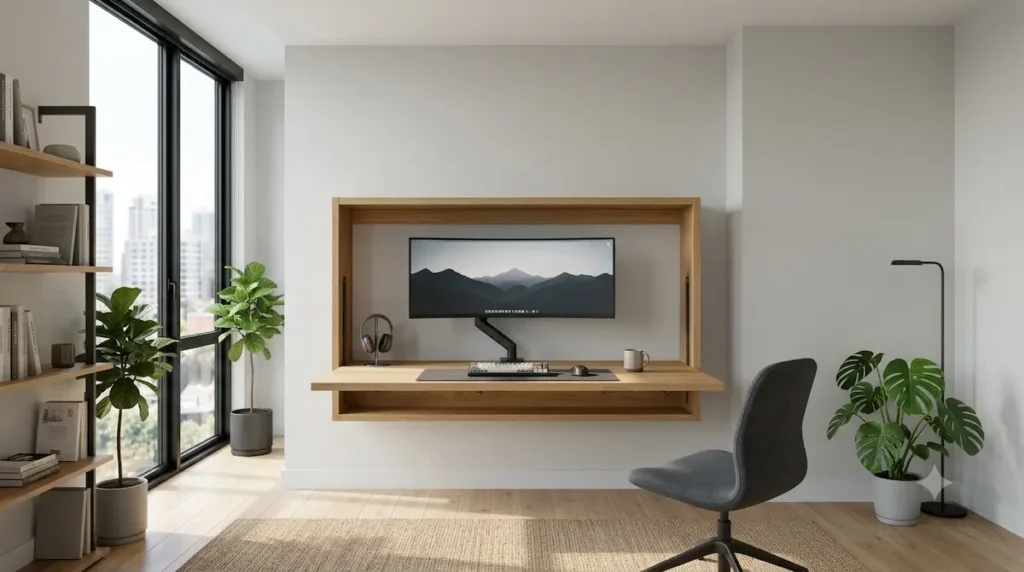
The Reality of Renting: Let’s look at this problem honestly. We’ve all seen the gorgeous, space-saving heavy-duty Murphy desks online. They look perfect for a clean, modern workspace. But for those of us living in rental apartments, these designs introduce an immediate, practical problem: landlord anxiety.
Standard installation manuals always assume you are mounting directly into solid wood wall studs. But what happens if the layout of your rental room forces you to mount your folding workspace onto thin, hollow drywall? If you guess incorrectly, a heavy mechanical load pulling down repeatedly on bare plaster will eventually fail—and losing your security deposit over wall damage is a frustrating setback no one wants to deal with.
As an independent lab, our goal isn’t to sell you furniture or tell you to cross your fingers and hope for the best. We want to look at the actual physics of drywall limits. That is exactly why we built the Interactive Spatial Computing Analysis Engine below. By checking the precise thickness of your wall panel against your actual gear weight, you can see the math for yourself and make an informed, safe decision for your apartment.
📋 Transparency Disclosure: To keep our research laboratory fully independent and free from annoying pop-up banner ads, some of the links generated by our calculators are affiliate tracking links. If you choose to click through and purchase an approved hardware kit, we will earn a small financial commission from the retailer at absolutely zero extra cost to you. We only recommend heavy-duty components that match our structural safe limits.
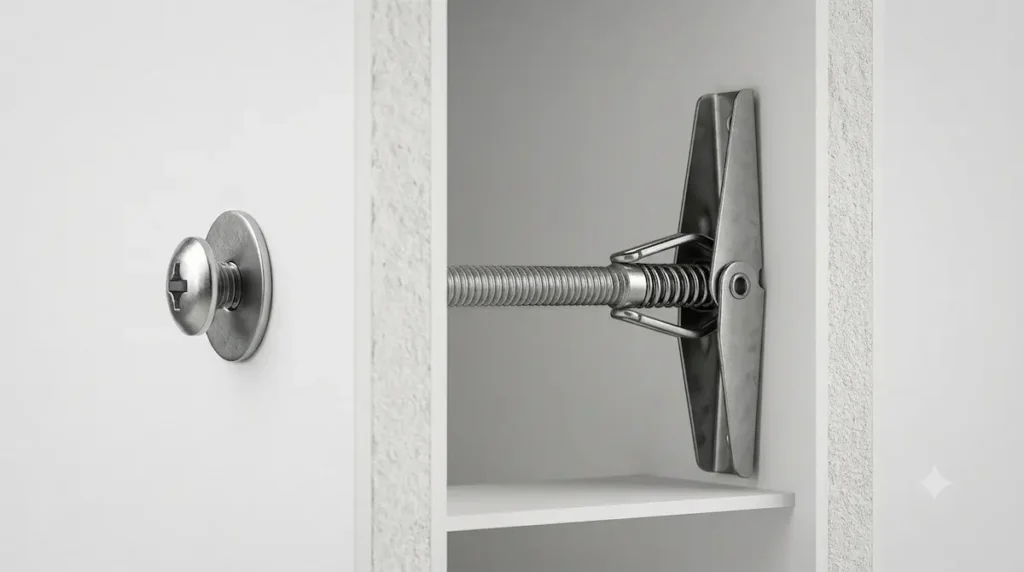
Drywall Shear Capacities for Heavy US Apartment Loads
Setting up a heavy workstation in a rental apartment shouldn’t feel like a legal gamble. Most standard residential leases explicitly ban drilling massive holes into wall studs, forcing you to find an alternative that won’t ruin your walls or your security deposit.
If you attempt to mount a standard, heavy-duty floating folding desk using basic retail wall anchors, you risk cracking the plaster, destroying your drywall, or losing a $2,000+ security deposit when the weight of multiple monitors pulls the frame clean out of the wall face. To protect your capital and your hardware, you must implement a studless, damage-free layout framework.
The Drywall Shearing Equation (Calculating Deflection)
Let’s be clear from an engineering standpoint: manufacturers do not build specialized “studless” folding desks. Every commercial wall workstation is designed assuming you will anchor it directly into solid wood wall studs. However, when apartment layout restrictions or lease parameters force you to mount your setup onto bare, hollow drywall, you have to bypass standard manuals. This blueprint outlines how to adapt any standard heavy folding desk for a completely studless installation by shifting structural loads onto high-capacity toggle anchors.
Before buying a folding desk, you have to look closely at the hardware torque. A wall-mounted folding workspace doesn’t just sit flat—it exerts constant pulling pressure on your drywall every time you put weight on it. A wall-mounted folding desk does not just occupy space when flat; it applies downward rotational torque to its mounting points whenever hardware weight is loaded onto the surface.
To guarantee that your multi-monitor arms or telerobotics tracking frames do not cause sudden drywall failure, you must calculate your exact structural threshold before installation:
Max Safe Operational Load (lbs) = (Drywall Thickness in mm × Anchor Count) × 1.3
For instance, a standard US rental bedroom utilizing a 12.7-mm drywall pane without stud backing can safely sustain an operational shear load of only 84 lbs when utilizing standard plastic anchors. Exceeding this boundary causes visible sagging and tracking calibration errors.When calculating the dynamic physics behind multi-monitor setups and folding mechanical desk panels, guessing is not an option. According to safety data frameworks monitored by the US Consumer Product Safety Commission, structural furniture stabilization and correct anchoring vectors are vital to preventing sudden mechanical shear failure under repeated loading stresses.
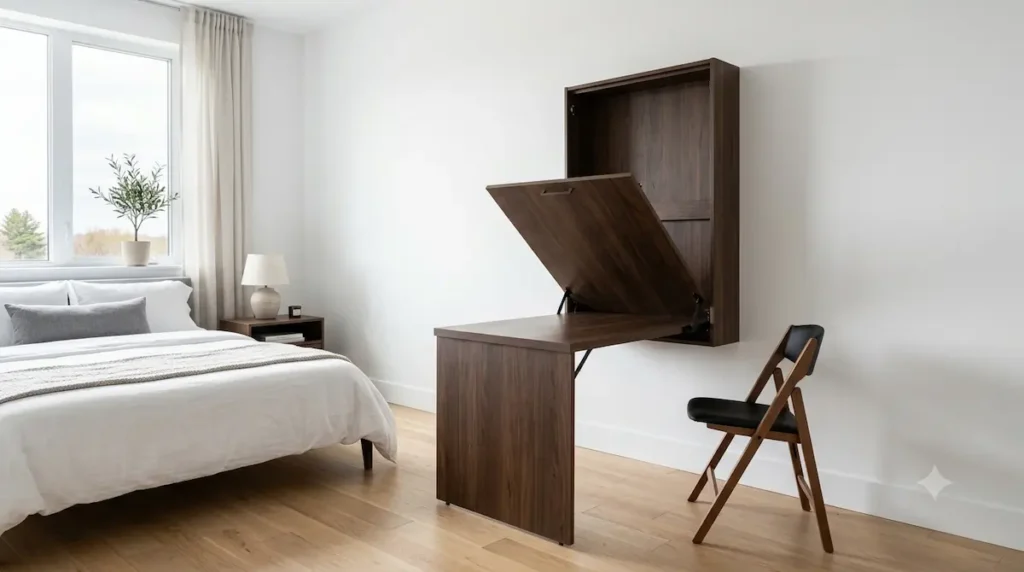
Top 3 Studless Heavy-Duty Mounting Systems (2026 Renter Alternatives)
If you want to keep your landlord happy and your hardware secure, these three zero-damage setups get the job done without drilling a single wall hole:
- The Post-Clamped Murphy Deck V4: Specially engineered to clamp directly onto dual matte-black structural tension poles, routing 100% of your monitor hardware weight into the floor and ceiling rather than the wall.
- The Track-Suspended Over-Door Frame: Utilizes ultra-thin, high-tensile steel brackets that hang over standard apartment doors, securing a rigid 60×40 cm drop-leaf platform without driving a single screw.
- The Industrial Compression Lever Bench: Built with adjustable rubber-tipped tension pads that brace tightly between your floor baseboards and wall moldings, creating a rock-solid, wobble-free anchor grid.
🔒 [TOOL] THE APARTMENT DEPOSIT SAFEGUARD SCHEMATIC GENERATOR
While the technical metrics above outline the core physics of studless wall installations, a minor calculation error can ruin your tracking fields and compromise your lease. Use our automated layout generator below to verify your exact room dimensions and load thresholds before purchasing any hardware components.
💡 Pro-Tip for Spatial Tracking Stability: If you are mounting your heavy-duty Murphy desk setup to support an advanced spatial computing environment or VR gaming station, vertical stability is critical. To avoid micro-wobbles and anchor your room tracking sensors cleanly in the corner without putting more holes into your lease walls, review our step-by-step No-Drill VR Sensor Mount Setup Blueprint. To keep your desktop surface entirely clear and stable under heavy usage, avoid heavy traditional desk clamps that strain your workspace wood. Instead, pair your layout with the best pole mount monitor arms for renters to elevate your screens safely using vertical tracking columns.
Additionally, keep in mind that even wall-braced systems can transfer structural vibrations downward if their lower support frames or surrounding floor interfaces rest on wall-to-wall rugs. If your home office workstation suffers from continuous frame sways or display bounce, implement our mechanical stabilization manual on how to stop desk from shaking on carpet to deploy rigid interlocking shims or subfloor-grounded spikes that freeze your coordinate mapping completely.
🛠️ The 3-Step Move-Out Restoration Blueprint (Zero Trace)
When your lease ends and it is time to move out, restoring your drywall to a pristine, 100% lease-compliant state takes less than 5 minutes per hole. Follow this exact process to leave no trace behind:
- Drop the Anchors: Unscrew the steel machine bolts to remove your desk brackets. Take a standard screwdriver or a hammer handle, place it against the exposed plastic outer rim of the wall anchor, and tap it firmly into the wall cavity. The inner metal toggle wing will drop harmlessly down inside the empty stud bay forever.
- Apply the Putty: Take a pea-sized dab of standard white drywall spackle paste (plaster filler) on your finger or a putty knife. Press it firmly into the clean circular drill hole, scraping any excess paste flat against the wall sheet.
- Blend and Paint: Let the paste dry for 30 minutes, then lightly smooth it down with a fine-grit sanding pad until it sits completely flush with the surrounding wall. Dab a tiny amount of matching apartment wall paint over the spot using a small sponge.
By the time your landlord walks in with their inspection clipboard, the holes will be completely invisible—legally classifying the installation as normal wear-and-tear and keeping your security deposit 100% safe!
🏛️ About RenterEase: As an elite spatial engineering publication, RenterEase is dedicated exclusively to helping remote professionals, immersive tech users, and apartment renters transform standard compact floor plans into high-efficiency production hubs . By auditing versatile multi-functional furniture form factors, analyzing structural weight distribution profiles, and mapping non-destructive hollow-wall anchoring alternatives, our layout specialists remove the constraints of working within constrained urban layouts . Every space-saving desk analysis, installation blueprint, and hardware integration layout across our repository is rigorously optimized to elevate your daily workflow, maintain absolute lease compliance, and fully insulate your tenant security deposit from structural property damage .
Affiliate Disclosure: RenterEase participates in selective affiliate marketing networks. This means we may receive a small financial commission on sales tracked through our curated product links to retail partners, at completely zero additional cost to you. We exclusively highlight high-fidelity hardware configurations, network nodes, and workspace optimization gear that meet our strict landlord-safe compliance standards.
🏛️ Technical Disclaimer: The physical furniture assemblies, studless wall mounting configurations, heavy-duty load calculations, and interactive algorithmic weight-capacity tool outputs mapped out across this article, along with all accompanying blueprint schematics and construction illustrations, are presented strictly for general educational, instructional, and illustrative troubleshooting purposes. RenterEase assumes no physical liability, structural equipment failure, property damage, or financial responsibility for drywall fracturing, stripped toggle bolts, loose wood trimming, accidental structural wall punctures, dropped desk components under load, or programmatic rounding discrepancies and computational errors generated by the integrated weight-capacity calculator. All readers build mechanical assemblies, mount heavy hardware fixtures, and calculate drywall structural load capacities at their own independent discretion.
Pingback: No-Drill VR Sensor Mount Blueprints: The 40/60 Rental Setup Guide
Pingback: Best Magnetic Stud Finder Apartment Drywall Guide
Pingback: Telepresence Home Office Setup Guide for Remote Operators
Pingback: Next-Gen Spatial Workspaces: Designing for 2027 Volumetric Pass-Through and Neuro-Telemetry Boundaries in Rentals
Pingback: Spatial Workspace Clearance Calculator: Volumetric Tracking Bounds - RenterEase
Pingback: How to Stop Desk From Shaking on Carpet: The Structural Stabilization Guide - RenterEase