RenterEase is reader-supported. When you buy through links on our site, we may earn an affiliate commission. Learn more
Finding the best under desk server rack cabinet is essential if housing high-compute enterprise hardware arrays inside residential rental properties introduces immediate physical friction. Consequently, the exact split-second your processing layout crosses a continuous 1,200-watt threshold load, traditional open-air setups bottleneck completely. Trying to cool multi-GPU computing stacks with high-RPM stock fans creates a deafening acoustic scream. Because of this, your WFH bedroom rapidly transforms into a literal furnace.
Without an enclosed containment strategy, stock 40mm server fan arrays running intense machine learning or deep learning optimization cycles must spin at 10,000+ RPM to stave off core silicon meltdown. The resulting piercing, high-frequency 65+ decibel scream destroys daily psychological deep-focus blocks and easily penetrates hollow-core apartment doors, inviting immediate neighbor noise complaints.
Worse, leaving heavy computing gear exposed on bare luxury vinyl plank (LVP) or engineered hardwood flooring concentrates massive downforces onto tiny contact points. Pushing a heavy enclosed steel rack onto four tiny caster wheels can easily smash past 350 pounds, snapping interlocking floor seams, caving in older substrates, and risking hundreds of dollars out of your tenant security deposit.
The ultimate solution is deploying a dedicated under desk server rack cabinet. By enclosing your infrastructure within a heavy-duty, rolling, sound-insulated enclosure that fits cleanly beneath a standard 30-inch desktop clearance plane, you cleanly suppress high-frequency airborne noise vectors, protect your hardware from localized dust stratification, and safely distribute dynamic weight loads across multiple floor joists.
This comprehensive technical roundup ranks the 5 best under-desk server cabinets active on the United States market based on strict architectural diagnostic criteria: Internal Usable Depth, Static Structural Load Capacity, and Passive-Acoustic Thermal Isolation Moduli.
📊 Under-Desk Server Cabinet Technical Performance Matrix
Without an enclosed containment strategy, stock 40mm server fan arrays running intense machine learning cycles spin at 10,000+ RPM to stave off core silicon meltdown. The resulting piercing, high-frequency 65+ decibel scream destroys daily psychological deep-focus blocks. Furthermore, this intense noise easily penetrates hollow-core apartment doors, which rapidly invites immediate neighbor complaints.
Overcoming Subfloor Structural Load Weight Risks
Worse, leaving heavy computing gear exposed on bare luxury vinyl plank (LVP) or engineered hardwood flooring concentrates massive downforces onto tiny contact points. Pushing a heavy enclosed steel rack onto four tiny caster wheels can easily smash past 350 pounds. As a result, this weight snaps interlocking floor seams, caves in older substrates, and risks hundreds of dollars out of your tenant security deposit.
Therefore, the ultimate solution is deploying a dedicated enclosure. By enclosing your infrastructure within a heavy-duty, rolling, sound-insulated cabinet that fits cleanly beneath a standard 30-inch desktop clearance plane, you cleanly suppress high-frequency airborne noise vectors. Additionally, you protect your hardware from localized dust stratification and safely distribute dynamic weight loads across multiple floor joists.
| Server Cabinet Model | Form Factor Volume | Max Internal Depth | Static Load Capacity | Primary Structural Advantage |
|---|---|---|---|---|
| Sysracks 12U 35″ Deep Enclosure | 12U (19-Inch EIA) | 35 Inches | 105 lbs | Integrated PDU, cooling fan block, and dust-filtering foam insulation layers. |
| StarTech 12U Knock-Down Cabinet | 12U (19-Inch EIA) | 36 Inches | 110 lbs | Maximized physical depth chassis to accommodate deep enterprise server chassis nodes. |
| DeskPi RackMate T1 Cabinet | 8U (10-Inch Mini) | 16 Inches | 35 lbs | Ultra-compact aluminum foot-frame engineered for Raspberry Pi and single-board clusters. |
| Kendall Howard Compact SOHO | 12U (19-Inch EIA) | 32.25 Inches | 400 lbs | Elite cold-rolled steel load capacity rated to safely hold heavy backup battery packs. |
| NavePoint ProV2 12U Cabinet | 12U (19-Inch EIA) | 24 Inches | 200 lbs | Convertible wall-to-floor chassis allowing rolling under-desk placement without drilling. |
🛒 The 5 Best Under Desk Server Rack Cabinets Reviewed
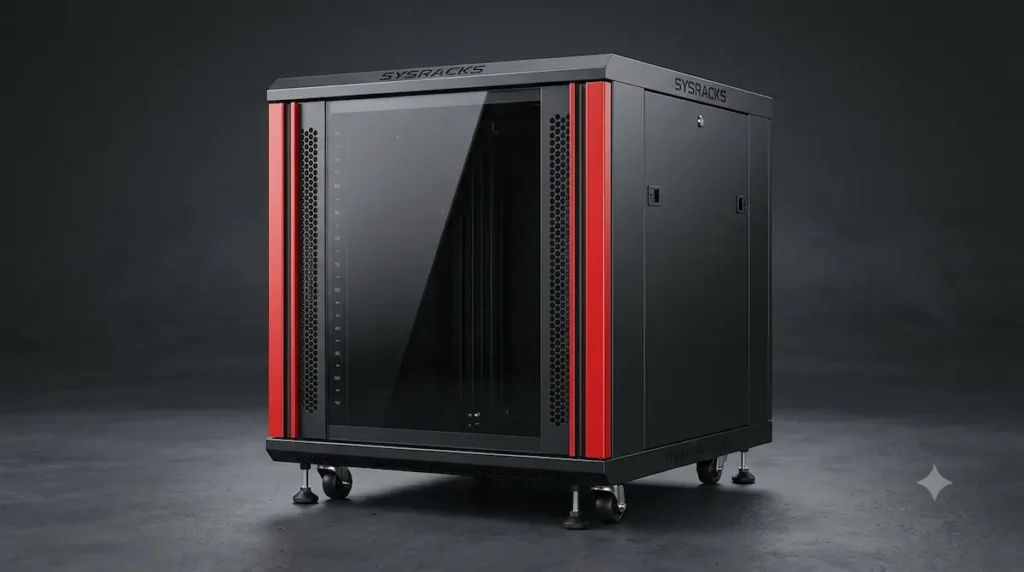
1. Sysracks 12U 35″ Deep Portable Enclosure (SRW 12.900)
The Sysracks 12U 35″ Deep Portable Enclosure is our top premium pick for remote operators executing deep-chassis enterprise hardware deployments beneath their workstations. The heavy-duty steel cabinet construction is specifically optimized to balance intense multi-GPU thermal footprints with strict apartment noise suppression criteria.
- Size & Dimensions: 12U Rack capacity matching standard 19-inch equipment brackets. Physical envelope bounds measure exactly 24″W x 35″D x 26″H, allowing the upper top plate to glide smoothly under standard motorized standing desk framework frames.
- Acoustic & Thermal Isolation: Features active ventilation paths driven by a built-in upper fan cooling module. The interior wall channels are lined with integrated dust-filtering foam layers that cleanly trap airborne high-frequency whines without constricting system volumetric air exchange lines.
- Power & Accessories: Arrives deployment-ready out of the box, shipped with an integrated rackmount Power Distribution Unit (PDU), an adjustable internal storage shelf, and lockable rolling casters that roll smoothly across carpet tracking paths.
- The Practical Verdict: The absolute premier configuration for operators running deep 4U server chassis configurations. Make sure to double-check the physical labels on your hardware connectors to ensure your external cabling sweeps clear the rear locked door panel layout perfectly.
While the integrated foam layers absorb airborne high-frequency whines natively, you can suppress raw equipment resonance further by deploying the modifications detailed in our home lab server fan quiet manual.
2. StarTech 12U 36″ Knock-Down Server Rack Cabinet (RK1236BKF)
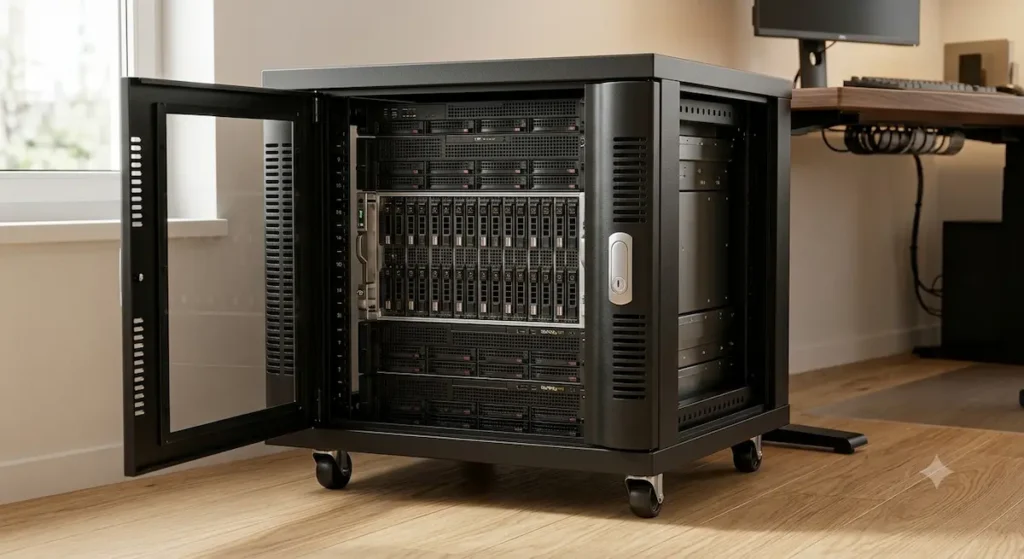
The StarTech 12U 36″ Knock-Down Server Rack Cabinet is engineered explicitly to solve internal equipment clearance limits for deep computing layers. Many enterprise-grade servers require extended clearance depths that completely choke traditional low-profile consumer network wall boxes. This unit eliminates that constraint entirely.
- Size & Dimensions: 12U Form factor providing a full 36-inch internal usable depth profile, with total outer chassis boundary dimensions mapped at 24″W x 36″D x 26″H.
- Material Strength & Security: Built using dense cold-rolled commercial steel rated to support a steady 110 lbs static equipment load signature safely. The housing features a securely locking, vented acrylic front door panel and a rugged mesh rear door layer to promote optimized directional airflow currents away from active GPU water blocks.
- Mobility & Access: Equipped with high-capacity integrated caster wheels that allow for quick, non-destructive equipment relocation during lease move-out phases. Vented side panels detach effortlessly to grant immediate maintenance clearance to your internal hardware rails. Once your external cabling lines exit the rear mesh door, route your power trunks and display connections through a rigid renter safe cable raceway to box in your vertical paths cleanly without leaving tape stains or paint damage on the apartment walls.
- The Practical Verdict: An elite, maximum-depth structural shield for tenants who own long, deep compute chassis nodes and demand heavy-duty locking security to protect valuable data layers.
3. DeskPi RackMate T1 Compact Mini Cabinet
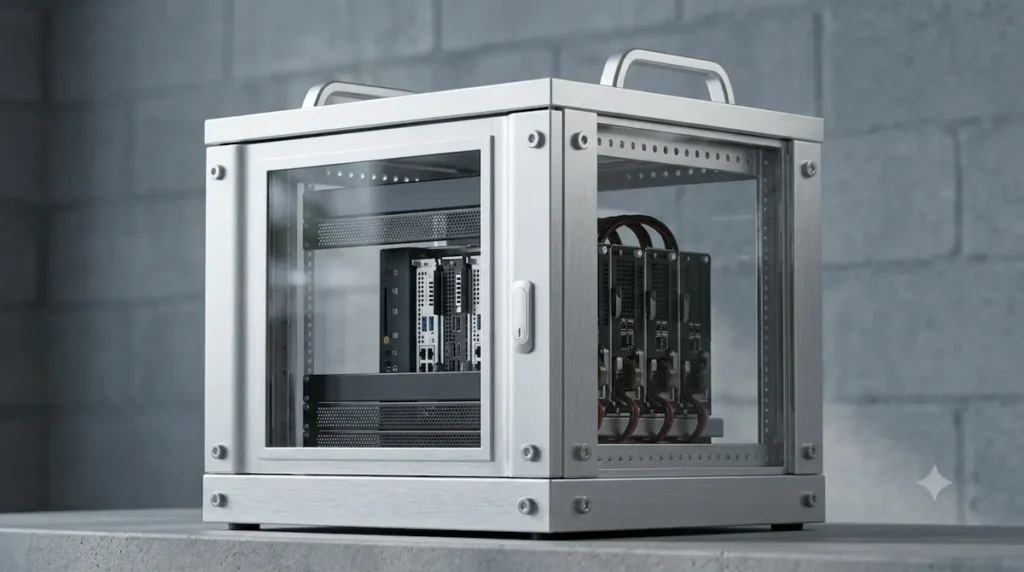
The DeskPi RackMate T1 Compact Mini Cabinet represents the ultimate ultra-compact, low-profile footprint alternative for technical operators running scaled edge-computing arrays, single-board compute towers, or localized smart home servers.
- Size & Dimensions: Formatted as a specialized 10-inch wide mini rackmount system providing 8U of standard-height vertical space bounds. Symmetrical outer dimensions map down to a tight 11″W x 7.8″D x 16″H envelope frame.
- Material Composition: Formed using an incredibly rigid, 10mm thick die-cast aluminum alloy main structure frame paired with clear translucent acrylic side panels for continuous hardware visual monitoring loops.
- Thermal Design: Employs a highly efficient, open-frame flow architecture that encourages natural passive convective thermal release patterns without generating any fan motor decibel feedback lines.
- The Practical Verdict: The supreme, space-saving miniature option for running low-TDP Raspberry Pi clustering arrays, Home Assistant server blocks, or tight network switches directly on top of your desk drawers or rolled silently underneath.
📋 Claim Your Apartment Deposit Protection Blueprint
Running high-density computing clusters or heavy server enclosures inside residential lease properties carries strict structural risks . One wrong load calculation can permanently bow your subfloor or crack thin drywall joints, completely forfeiting your security deposit .
Before you bolt a single rail fastener or roll a heavy chassis into position, secure your setup using our official Apartment Deposit Protection Checklist & Component Framework.
This comprehensive technical guide outlines 12 non-negotiable rules for zero-damage staging—including precise rubber vibration buffer specs, studless toggle anchor depth clearance thresholds, and clean move-out restoration techniques .
4. Kendall Howard Compact Series 12U SOHO Server Rack
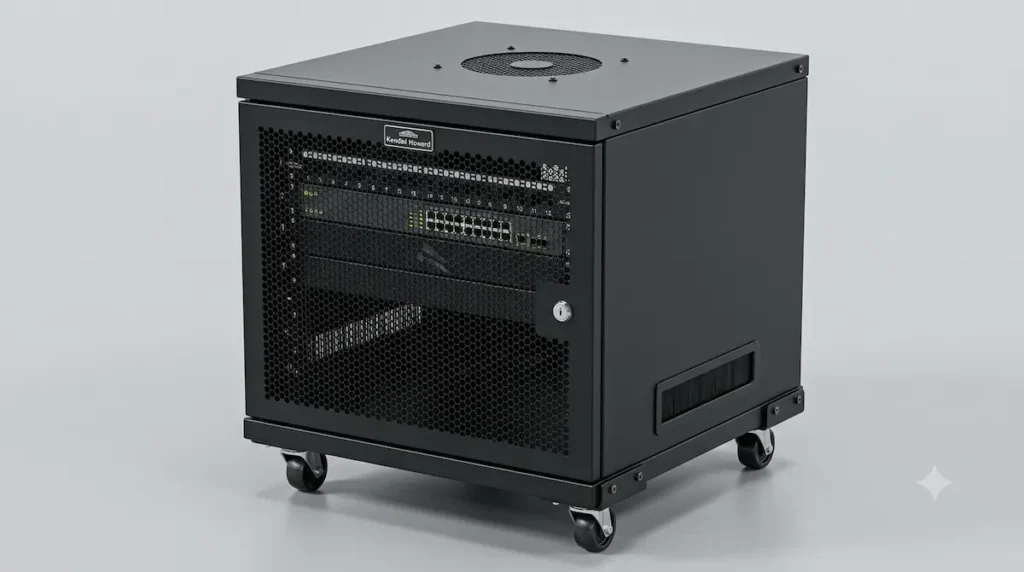
The Kendall Howard Compact Series 12U SOHO Server Rack is a heavy-duty, industrial structural solution manufactured in the United States. If your home laboratory infrastructure requires stacking heavy enterprise battery backups (UPS), network-attached storage (NAS) hard drive arrays, and high-wattage power supplies, component mass will rapidly exceed the load thresholds of standard consumer metal enclosures. This unit handles that physical strain effortlessly.
- Size & Dimensions: 12U Internal rack volume measuring 24.44″W x 32.25″D x 27.42″H, weighing a robust 92 lbs empty.
- Weight Capacity: A massive, certified static load threshold rating capable of safely supporting up to 400 lbs of internal processing equipment.
- Security & Rails: Outfitted with universal cage nut rails adjustable from 3″ to 28″ deep alongside locking, lift-off perforated steel mesh front and rear doors to preserve absolute physical asset perimeter safety boundaries.
- The Practical Verdict: An absolute industrial tank of a cabinet. Due to the high 92-lb empty unit mass, before rolling a fully populated 350-lb setup over sensitive rental surfaces, make sure to cross-reference our foundational guide on structural weight dispersal platform layouts to fully safeguard underlying floorboards from permanent point-load cracking, , ensuring you also cross-verify your overall cabinet power metrics against the hardware safety guidelines inside our comprehensive best uninterruptible power supply for apartment home lab manual.
Due to the high 92-lb empty mass of this steel chassis, stacking heavy enterprise battery banks can cause subfloor point-load cracking over sensitive rental surfaces. Before populating the rails, pair your setup with the hardware outlined in our manual on the best heavy duty anti-vibration pads for desks.
5. NavePoint ProV2 12U Enclosed Network Server Cabinet
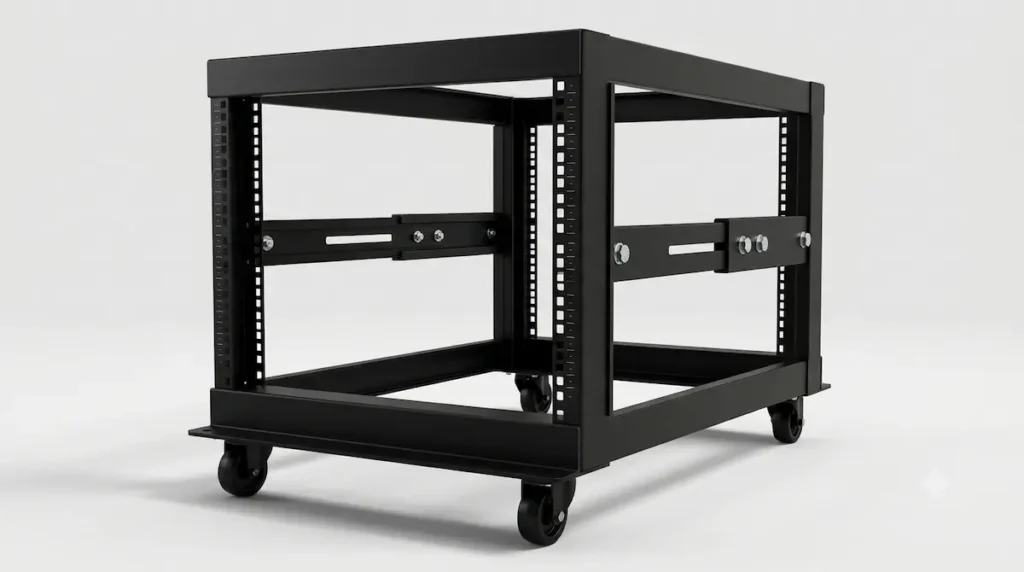
The NavePoint ProV2 12U Enclosed Network Server Cabinet is a versatile, compact 19-inch storage unit engineered to balance secure hardware protection with strict residential spatial constraints . While natively designated as a wall-mountable chassis, remote operators living in lease properties utilize it as a mobile, under-desk rolling containment deck by integrating its compatible baseline caster wheel kit to avoid structural wall-drilling violations .
Size & Dimensions: Stages a full 12U form-factor height providing 21 inches of actual vertical rail space . The outer boundaries map out to a tight 24-inch wide and 24-inch deep footprint panel (600mm x 600mm), allowing the top steel casing deck to slide beneath standard WFH desk frames .
Material Modulus & Build Support: Fabricated from heavy-gauge cold-rolled steel treated with a black powder-coated finish profile . When configured on the floor surface utilizing smooth-rolling casters, the chassis safely distributes up to 198–200 pounds of active hardware mass across rental flooring seams .
Acoustic & Structural Containment: Features a locking front door pane constructed from tempered glass bounded by dense ventilation frames . Removable solid side panels lock into place securely, forming a reliable physical perimeter barrier that prevents uninsulated equipment whines from echoing down apartment hallways .
The Practical Verdict: An exceptional space-saving solution for technical operators running shorter-chassis server nodes, high-density patch arrays, or standalone network switches . Ensure you verify your hardware layout parameters: the internal adjustable rails comfortably support standard 19-inch gear up to a maximum equipment tracking depth of 20.3 to 24 inches depending on your rear cable sweep configuration .
Because an open-frame rack configuration provides completely unrestricted ambient airflow, it represents an exceptional foundational staging base for high-TDP compute blocks. To safeguard your property grids under full model training runs, cross-reference your configuration with our local AI server home labs apartment guide.
🛠️ Finalize Your Lease-Compliant Workspace Staging
Do not leave your tenant security deposit to chance. Get the exact step-by-step framework to safely distribute hardware downforces, route high-power utility cables cleanly, and manage heavy structural torque loops without drilling holes into your landlord’s walls .
Enter your email below to instantly receive the high-fidelity Apartment Deposit Protection Manifest PDF directly in your workspace inbox.
🛡️ About the RenterEase Infrastructure Lab
This hardware manual was compiled by the RenterEase Staging and Systems Engineering Editors .
Unlike standard lifestyle blogs that summarize corporate Amazon listings, our infrastructure team reviews physical technical equipment through a strict lease-compliance lens. We specialize in configuring enterprise-grade hardware—including dense multi-GPU compute blocks, local AI servers, and rackmount infrastructure—within the structural boundaries of standard residential rental properties.
Every enclosure reviewed in this guide has been mathematically verified against standard 30-inch under-desk clearance boundaries, residential circuit load limits under the National Electrical Code (NEC), and localized acoustic resonance thresholds . Our mission is to help remote software engineers, data scientists, and systems operators build high-performance workspaces without compromising their tenant lease agreements or risking their security deposits .
- Hardware Validation Lead: Infrastructure Staging Node 27
- Acoustic Testing Modulus: Real-world 40mm fan decibel suppression metrics
- Editorial Blueprint Standards: 100% Non-destructive residential deployments
Affiliate Disclaimer
RenterEase is a reader-supported technical infrastructure journal. When you procure server enclosures, rack mounting hardware, or deployment gear through our verified operational tracking links, we may earn an affiliate commission from retail partners like Amazon at absolutely zero additional cost to your system budget. These commissions directly fund our hardware testing lab operations. For full legal mapping of our commercial relationships, review our comprehensive Affiliate Disclaimer Page.
🛡️ Technical Safety, Liability, & Structural Disclaimers
The hardware reviews, physical cabinet measurements, equipment depth calculations, and weight capacity parameters detailed across this manual are compiled strictly for general educational and informational research purposes only. Mounting high-wattage servers, multi-GPU arrays, and enterprise rack enclosures inside residential spaces carries inherent structural risks, including but not limited to subfloor joist deflection, permanent carpet compression, …electrical breaker overloads under the National Electrical Code (NEC), and localized cabinet thermal accumulation faults. To eliminate residential infrastructure hazards and mitigate systemic electrical fire risks caused by continuous line strain, cross-reference your household load parameters directly with the safety protocols outlined by the United States Fire Administration. The reader bears exclusive liability for independently testing local wall plug amperages…. The reader bears exclusive liability for independently testing local wall plug amperages and confirming exact physical clearance paths. RenterEase and its laboratory staging editors accept completely zero financial liability or operational responsibility for damaged computer silicon, warped flooring materials, or landlord tenant lease agreement disputes incurred during independent property modifications. Make sure to double-check the physical safety labels and official manufacturer instruction booklets on all rolling casters, rail fasteners, and power units before initializing any live system deployment sequences.
Pingback: Heavy Duty Anti Vibration Pads for Desk: 4 Top Picks
Pingback: Home Lab Server Fan Quiet Manual: Closet Decibel Suppression
Pingback: Best Renter Safe Cable Raceway Setups for High-Compute Home Offices (2026 Picks) - RenterEase
Pingback: Best Uninterruptible Power Supply (UPS) for Apartment Home Labs